Today, the Shropshire Union Canal is one of the quiet pleasures of living around Gnosall, much loved by everyone I've ever spoken to. Walkers, cyclists, anglers and narrowboats pass through a landscape which, for the most part, feels reassuringly peaceful.
But on a dark January winter's night in 1879, according to a story recorded by one of Britain's best-known folklorists, something very, very peculiar happened along the canal - an encounter with something that strangely, local people seemed to already know about.
They called it the Man-Monkey.
A journey home in the dark
Picture the story, which begins on a dark Tuesday night on 21 January 1879.
A labourer had been employed to transport a cartload of luggage from Ranton - just a couple of miles north of our own village. Little is known about the purpose of his journey, although men working as blacksmiths, wheelwrights, carpenters and general carriers would regularly have transported goods between the small towns and villages of the area. Records show that these trades were very likely present in Ranton.
This man's journey was on a horse-drawn carriage, and his destination was Woodcote, beyond Newport in Shropshire.
After delivering his goods, his return journey was slow. His horse was tired and by around ten o'clock that evening the pair were still making their way through the Staffordshire countryside.
Eventually they approached a road bridge over what was then known as the Birmingham and Liverpool Canal, which later became part of the Shropshire Union Canal system we love and cherish today.
It was here that an otherwise mundane journey apparently took a strange - and frightening - turn.
According to the account recorded by author and folklorist Charlotte ("Lotty") Sophia Burne, a strange black creature suddenly jumped out from the bushes next to the towpath.
It had striking white eyes.
And it leapt onto the horse.
The creature on the horse
Naturally, the exhausted animal panicked in surprise. Reacting quickly, the driver attempted to knock the creature away with his whip.
But then came perhaps the strangest detail in the entire story.
According to the man's later account, the whip passed through it.
Terrified, he dropped the whip and the frightened horse broke into a gallop, racing away with the mysterious black figure still clinging to it, and dragging the carriage - with the terrified man - some distance along the canal.
Exactly how the creature disappeared wasn't clear. The unfortunate driver seems to have remembered relatively little of what happened during the ensuing panic.
Eventually, however, he reached safety.
And before long, his extraordinary story was spreading through the local community.
Nobody wanted to cross the bridge
The encounter apparently caused quite a stir at the time, with the story even making its way into the Journal of the Folk-Lore Society in 1911.
When the story reached Woodseaves, it frightened at least one man sufficiently enough that he chose to remain with friends overnight rather than make his journey home across the same bridge. The original witness was reportedly badly shaken by what had happened.
There was, however, one intriguing detail that was slowly unravelling. The following day, a search was made for his missing whip.
It was found where he said he had dropped it.
For me, finding the whip doesn't automatically strengthen the credibility of the man's account, but it does raise questions, as it must have done almost 150 years ago when news of the Man-Monkey encounter was spready by gossip locally.
"That was the Man-Monkey"
A few days later, word of the incident had apparently become distorted into a report that the traveller had been stopped and robbed, and a local bobby became involved, and visited the man's employer to investigate further.
When the true story was explained to him, however, the police officer supposedly wasn't particularly surprised. He was a local man, and he knew the stories surrounding the bridge.
His explanation, preserved by Lotty Burne, was that everyone knew what it was that the traveller had encountered on that dark evening.
It was the Man-Monkey.
According to local tradition, the apparition had haunted the bridge since a man drowned in the canal - or the "Cut", as canals were commonly known.
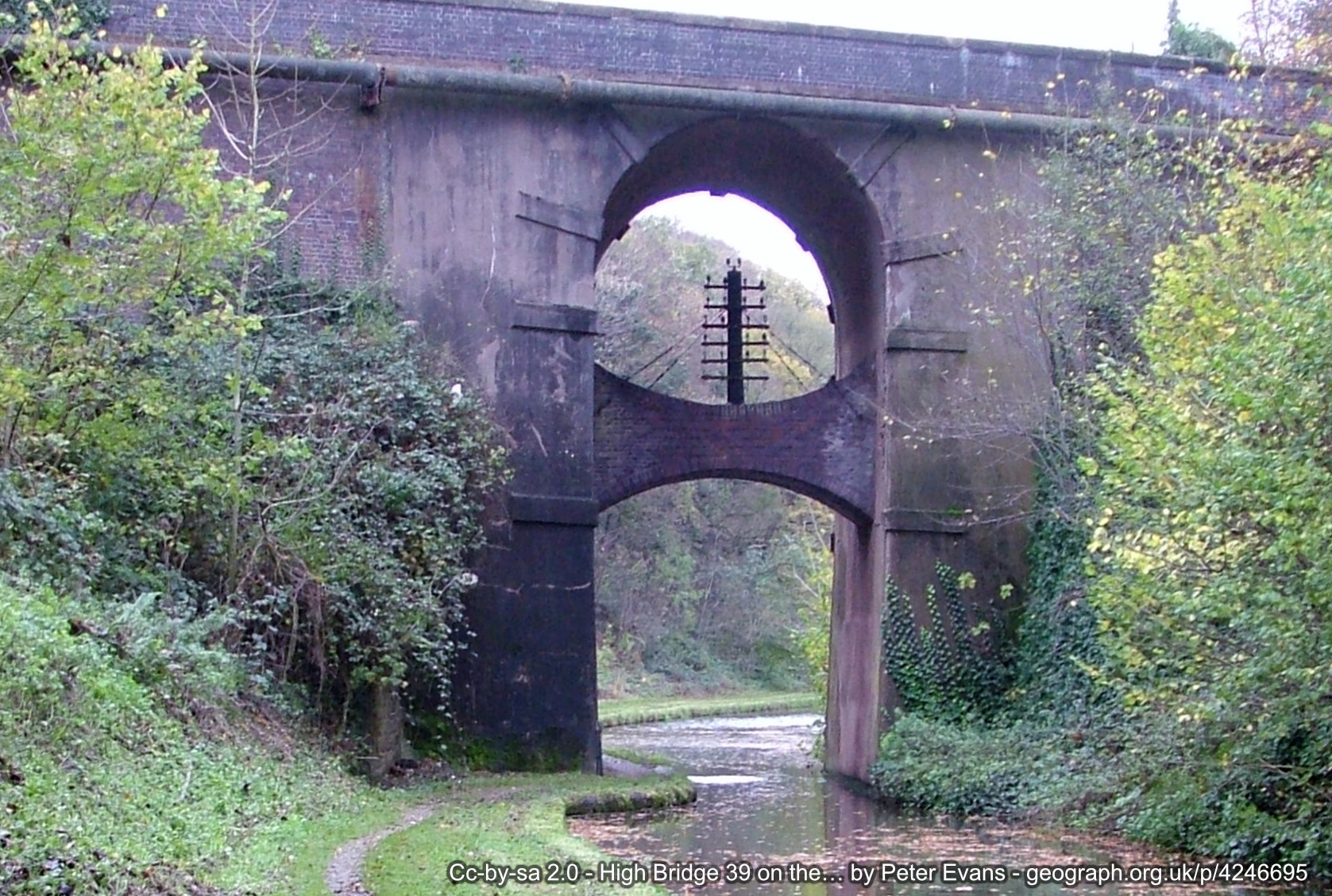
Bridge 39, at Grub Street Cutting, was built around 1833 as part of Thomas Telford's canal works. This particular bridge is quite unusual, and is celebrated as one of the most unusual and frequently photographed landmarks on the entire canal network. It was built to combat the immense lateral pressure from the cut, and has a distinct "double-arch". More unusually, it also has a telegraph pole within the upper arch, put in place in 1861.
Construction of the bridge would have been difficult - and dangerous. Whether anyone actually lost their life during its construction, however, I haven't been able to establish. Keep that thought in mind, though, because it's quite relevant. But for now, back to the story.
In early accounts, the Man-Monkey was described as "a strange black creature with great white eyes". At the time, it appears that no accurate description was given by the witness - no mention of fur, height, clothing, ape-like face, or even whether it stood upright.
It would be easy to dismiss the story entirely, until things become considerably more interesting: the terrified traveller of 1879 may not have invented the Man-Monkey at all. And the locals already knew of its existence.
An old story preserved in print
This is what separates the Bridge 39 Man-Monkey from many modern internet legends.
I have traced the story back into Victorian folklore. Lotty Burne included the incident in Shropshire Folk-Lore: A Sheaf of Gleanings, published in 1883, only a few years after the alleged encounter. She subsequently referred to the story in her 1896 work on Staffordshire folklore and returned to it in an address to the Folk-Lore Society published in 1911.
Lotty was not simply collecting entertaining ghost stories. She was an important early figure in the systematic study of folklore and eventually became the first woman president of the Folk-Lore Society. That doesn't make the Man-Monkey real, of course, but it does make the historical provenance of the story considerably more interesting.
For her, stories such as the Man-Monkey offered a window into the beliefs and traditions of rural communities.
And the policeman's reaction was particularly revealing. To him, apparently, the creature wasn't some newly discovered monster. He was reported to have said:
“That was the Man-Monkey, sir, as always does come again at the Big Bridge, ever since the man was drowned in the Cut.
So what was it?
A century and a half later, there's still no obvious way of knowing what - if anything - the traveller encountered that night.
Perhaps a wild animal startled the horse.
Perhaps darkness, exhaustion and fear transformed something ordinary into something extraordinary.
Perhaps - and most likely of all - we will never know.
Victorian Britain certainly had no shortage of ghost stories, strange animals and supernatural folklore. But those explanations don't quite remove the most fascinating part of the tale.
Intriguingly, the story didn't entirely disappear with the Victorians. I tracked down an account of another sighting reproduced by Hypnogoria. It describes an appeal by the Canal & River Trust for ghost sightings, which revealed someone else's sighting of the Man-Monkey from a boating holiday not so long ago:
"[A narrowboater] told us that during a boating holiday on the 'Shroppie' in the 1980s he took the tiller while the family were inside the boat preparing lunch. Passing under a bridge he looked up to see what he described as "a huge black, hairy monkey" staring down at him."
Apparently, the narrowboater was previously unaware of the legend of the Man-Monkey.
Why did local people apparently already have a name for it?
The Man-Monkey wasn't simply described as an unknown creature. It was associated with Bridge 39 and, according to the tradition recorded by Burne, with an earlier drowning.
Very little is known about the circumstances surrounding the drowning, or who it was. I can find no reference to who this was, apart from Lotty's reference to "the man" in her presidential address to the Folk-Lore Society.
Could this mysterious drowning somehow have been connected with the construction of Bridge 39?
That places the story somewhere between ghost tale, local legend and what we might today call a cryptid.
It is also a reminder of how differently familiar landscapes can appear after dark.
A canal bridge that seems picturesque on a Sunday afternoon can feel considerably less inviting on a freezing January night, with no electric lighting, no houses nearby and only the sound of a horse's hooves and the black water of the Cut at your side.
And it's just along the canal from Gnosall
Perhaps the best part of the story for us is its geography.
This isn't a legend from the Scottish Highlands or some remote corner of Britain. It belongs to the countryside on our doorstep.
The same canal that passes through Gnosall continues towards Norbury and into the landscape associated with the Man-Monkey story. Generations have travelled this route: working boatmen, farm labourers, traders, families, walkers and, today, leisure boats and cyclists. And the occasional disgruntled swan who is upset that I've paddled too close to her cygnets whilst out kayaking.
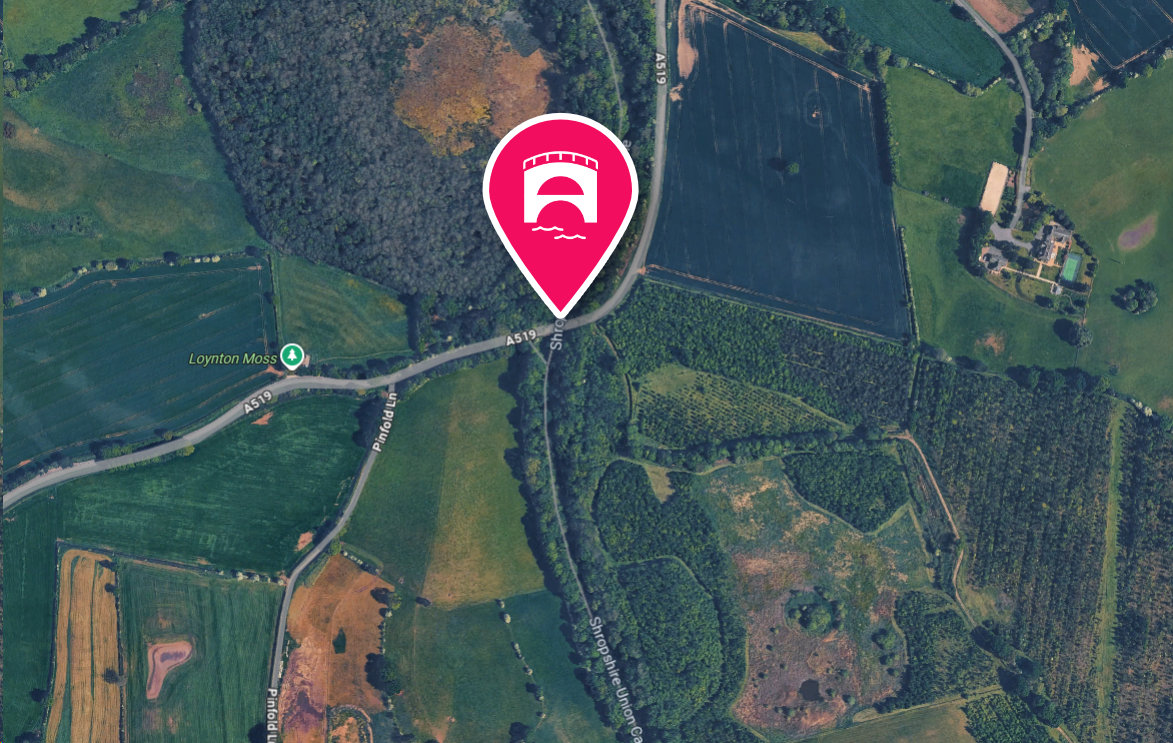
But somewhere along our quiet stretch of Staffordshire canal lies a bridge that once had a deeply unsettling reputation - a place where, according to Victorian folklore, something strange lay in wait.
So, next time you set off along the canal from Gnosall, spare a thought for that frightened traveller making his way home in January 1879.
And if you're walking back after sunset and notice something black watching from the hedgerow with two unusually pale eyes...
Perhaps don't stop to investigate.
Sources
Notes: The story was recorded by pioneering folklorist Charlotte Sophia Burne during the Victorian period and subsequently appeared in Folk-Lore. However, some details found in modern retellings, including the precise identification of High Bridge No. 39 as the “Big Bridge” should be regarded as later interpretations rather than established historical fact. Main photo is an artistic representation of the Man-Monkey.